
The Structural Problem: Combinatorial Entropy
In the domain of national pension projections, complexity is not an implementation detail; it is the primary characteristic of the system. We are not building a standard behavioral model with rich state transitions; we are engineering a Policy Engine capable of forecasting rights over 40 years across a fractured legislative landscape.
The architectural challenge can be formalized as a combinatorial explosion:
\[\text{System Entropy} \approx (\text{Career Hypothesis}) \times (\text{42 Independent Regimes}) \times (\text{Temporal Evolution})\]A standard layered architecture fails here because the rate of legislative change exceeds the maintainability threshold of a monolithic model.
This article details the architectural strategy used to decouple the Invariant (Time) from the Variant (Law), moving from a procedural script to a modular Computational Core.
1. Domain Analysis: Strategic DDD as a Discovery Tool
We utilized Domain-Driven Design (DDD) primarily for Strategic Design—to identify Bounded Contexts—rather than for tactical “Rich Entity” modeling.
We identified that the engine is Two-Dimensional:
- The Temporal Model (The Strategy): Defined by the Career Hypothesis (e.g., Salaried, Unemployment, Expatriation). This dictates the “shape” of the timeline.
- The Legal Policy (The Projector): Defined by the Regime (e.g., CNAV, AGIRC). This dictates the “math” applied within that timeline.
Architectural Decision: We reframed the system from a “Simulation Service” to a Federation of Projectors orchestrated by Hypothesis Strategies.
2. The Architecture: Isolation for Testability
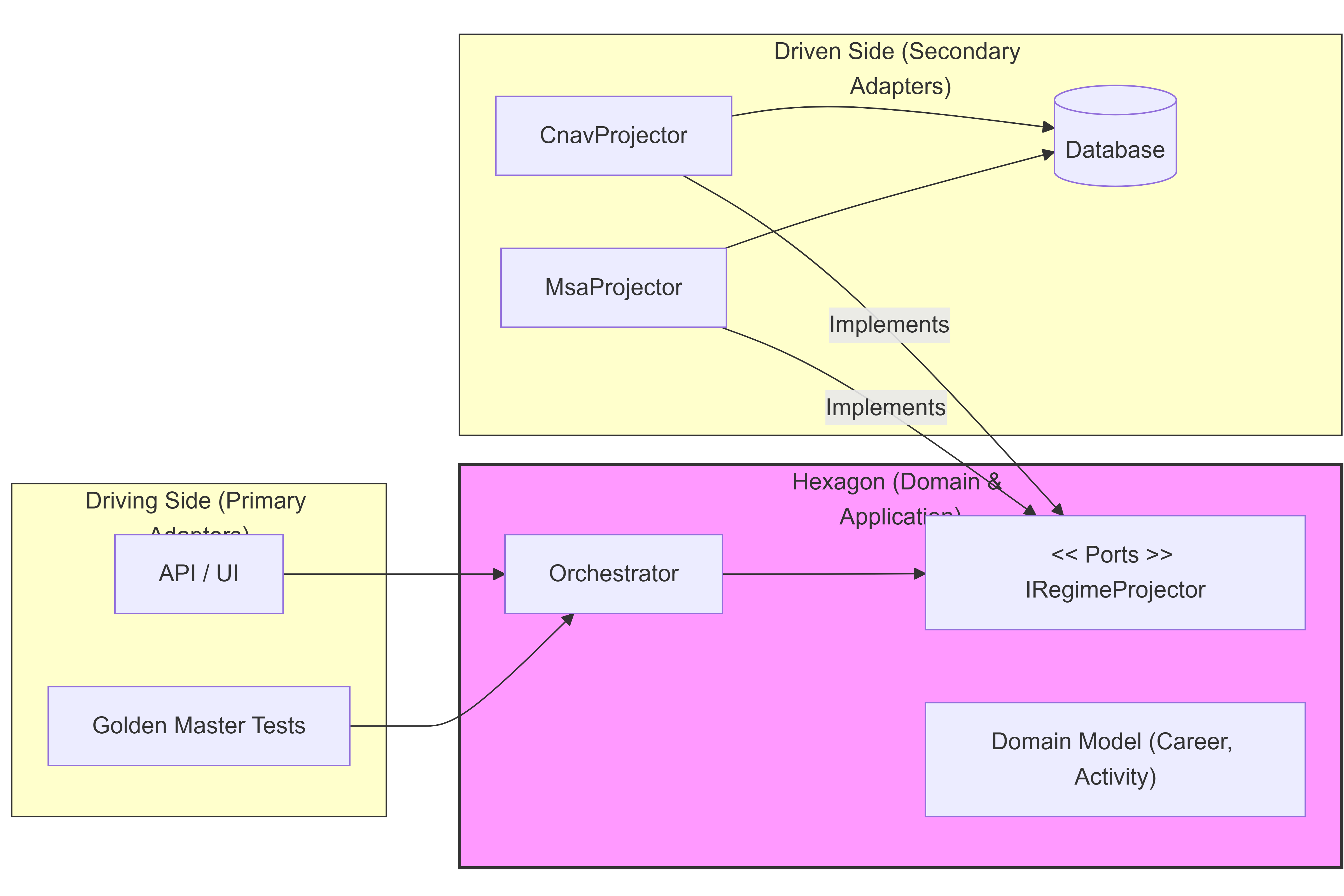
We adopted Hexagonal Architecture (Ports & Adapters). The primary driver was not just database decoupling, but Testability. We needed the ability to run the “Core Policies” in a vacuum—without the noise of the database or the API—to verify complex actuarial scenarios against a Golden Master.
Visualizing the Hexagon
Notice how the Orchestrator coordinates the flow without knowing the specific regime rules.
graph LR
    classDef lavender fill:#e6e6ff,stroke:#666,stroke-width:1px,color:black
    linkStyle default stroke:#333,stroke-width:1px,fill:none

    subgraph Driving ["Driving Side (Input Adapters)"]
        style Driving fill:#ffffcc,stroke:#333,stroke-width:1px,color:black,padding:30px
        API["API / UI"]
        Test["Golden Master Tests"]
    end

    subgraph Core ["Hexagon (Computational Core)"]
        style Core fill:#ff99ff,stroke:#333,stroke-width:1px,color:black,padding:20px
        Orch["Orchestrator"]
        Ports["<< Port >><br>IRegimeProjector"]
        Domain["Policy Engine<br>(Invariant Loop)"]
    end

    subgraph Driven ["Driven Side (Data Adapters)"]
        style Driven fill:#ffffcc,stroke:#333,stroke-width:1px,color:black,padding:20px
        SQL[("Reference Data")]
        Cnav["Cnav Policy"]
        Msa["Msa Policy"]
    end

    API --> Orch
    Test --> Orch
    Orch --> Ports
    Cnav -.->|Implements| Ports
    Msa -.->|Implements| Ports
    Cnav --> SQL
    Msa --> SQL

    class API,Test,Orch,Ports,Domain,SQL,Cnav,Msa lavender
3. Implementation: Modeling the Invariant
To enforce the Temporal Backbone, we chose Inheritance (Template Method) over Composition.
The Governance Trade-off: In a standard domain model, invariants should be enforced by the model itself, not by class hierarchy. However, in this regulated context, the projection loop is a Framework Concern. By embedding it in a BaseRegimeProjector, we treat it as “Domain Infrastructure,” ensuring that individual Policy implementations focus solely on arithmetic, without the ability to corrupt the timeline.
1
2
3
4
5
6
7
8
9
10
11
12
13
14
15
16
17
18
19
20
21
22
23
24
25
// The Framework Layer: Manages the Invariant
public abstract class BaseRegimeSalaireProjector<TData> : IRegimeProjector
{
    public abstract RegimeId Id { get; }

    public IReadOnlyCollection<Activity> Project(InputSalarie input, Context context)
    {
        var activities = new List<Activity>();
        var salary = input.BaseSalary;

        // The Invariant Loop: Enforced by the framework
        foreach (var period in context.ProjectionPeriod.SplitByYear())
        {
            salary = salary.ApplyInflation(context.Rate);

            // The Variant Hook: Where the Law is applied
            TData rights = CalculateRights(period, salary);

            activities.Add(new SalariedActivity(period, rights));
        }
        return activities;
    }

    protected abstract TData CalculateRights(Year year, Money salary);
}
4. Orchestration: Solving Real-World Friction
The complexity of the system is not just in the calculation, but in the wiring between the abstract Core and the concrete Infrastructure.
The Dynamic Sequence (Performance)
The Orchestrator delegates to a Loader port to fetch only the legislative parameters required for the user’s specific career history (O(1) filtering).
sequenceDiagram
    participant App as Orchestrator
    participant Loader as IRegimeLoader
    participant Bridge as ServiceBridge
    participant Projector as CnavProjector

    Note over App: 1. Identification
    App->>Loader: GetRequiredRegimes(Career)
    Loader-->>App: [CNAV, AGIRC]

    Note over App: 2. Optimized Loading (Sequential)
    loop For Each Regime
        App->>Loader: LoadReferenceData(RegimeId)
        Note right of Loader: Sequential await for EF Core safety
    end

    Note over App: 3. Execution via Bridge
    loop For Each Regime
        App->>Bridge: Execute Projector
        Bridge->>Projector: Project(Input, Context)
        Projector-->>App: Activity
    end
Language Friction: The “Bridge Tax” & Governance
Implementing this in C# required accepting Accidental Complexity. Since our Projectors are generic (<TData>), we faced covariance issues when injecting them into a unified collection. We introduced a Bridge Pattern to adapt specific inputs to the generic engine.
While this adds verbosity, it provides Governance via Compilation: it becomes physically impossible for a developer to pass “Unemployment Data” to a “Salaried Projector.” The compiler enforces the boundary between Hypotheses.
5. Business Impact: The Ultimate Test of Reversibility
The true validation of software architecture is not how fast you can build, but how safely you can change direction. We experienced this during the Pension Reform of 2023 and its subsequent Suspension in late 2025.
Phase 1: The Reform (2023)
The government shifted the legal Age of Departure.
- Legacy Impact: This would have required a risky rewrite of the main procedural loop, affecting all 42 regimes simultaneously.
- Architecture Response: We implemented a
Strategy2023for the specific CNAV Projector. The core loop (BaseProjector) remained untouched. Time-to-market: 2 days.
Phase 2: The Suspension (Dec 2025)
Two years later, political shifts led to the suspension of key parts of the reform.
- Legacy Impact: Unpicking “spaghetti code” logic intertwined with two years of subsequent patches. A nightmare scenario often leading to “frozen” releases.
- Architecture Response: Because the 2023 logic was an isolated Policy Strategy, we simply reverted the Orchestrator configuration to prioritize the previous strategy. Time-to-market: 2 hours.
Conclusion: The architecture provided Reversibility. In a volatile legislative environment, the ability to undo complexity is just as valuable as the ability to handle it.
Final Thoughts
This architecture is not a silver bullet. It introduces fragmentation and requires managing language friction (generics/covariance). However, for a regulated Policy Engine, it provides the necessary isolation to turn Legislative Volatility into a manageable software process.